
Maplewood Previous Residents by Era
Maplewood house history has several overlapping trails, each with a different date range and meaning. Essex PRESS records land instruments and parties, not daily occupancy. A directory provides a historical listing at a printed date. Newspapers can date a notice, and a map can add building context. Start with the most recent reliable property key, then select the source that fits the time period. The table identifies the evidence each source can actually supply and the route for reaching it.
| Source | Years It Covers | Where Held | What It Shows |
|---|---|---|---|
| Essex PRESS transaction index | From 10/01/1996 on the PRESS home page | Essex Register PRESS online | Recorded instrument details, grantor, grantee, and indexed block or lot fields |
| Register public-vault records | Remote/public-vault transactions from 05/01/2001 to present, with older material in the public vault | Essex Register and Hall of Records | Index or image access, subject to the Register's coverage limits |
| Maplewood city-directory scans | 1888-1970, 34 digitized editions | Maplewood Memorial Library digital archive | Dated address listings, names, phones, and street sequence |
| New Jersey state census method | 1855-1915 | House-history and archival research routes | Household context to compare with dated directory evidence |
| 1949 Sanborn map set | 1949 | Library of Congress cataloged map set | Historic building and land-use context, not a current boundary or resident list |
The Essex Register PRESS landing page distinguishes its electronic transaction index from the Register's public-vault and in-person title-search work. That distinction matters when a Maplewood address reaches an older transfer or a record without an electronic image.
Maplewood Previous Residents in PRESS
PRESS is the county system for recorded deeds, mortgages, liens, and related instruments. Its By Block and Lot option requires a municipality, block, and lot, then allows a date range or quick range. The municipality list includes Maplewood. A name search accepts a last name or company name and optional first name, document type, and dates. By Document Type requires a document type and From/To dates in MM/DD/YYYY, with quick ranges from three to 90 days. The range limit means a long trail may require several bounded searches.
Use the source as a reproducible index. Preserve the municipality, instrument number or book and page, document type, recording or transaction date, grantor, grantee, block and lot when indexed, image status, and source link. Older mortgage cancellations may have an index entry without an electronic image. The Register says PRESS is informational index and image access, while formal title searches require in-person examination.
Note: A recorded deed identifies a transfer between parties and does not establish that either party lived at the Maplewood address every day.
Maplewood Address Keys for Past Residents
Before opening the deed index, keep the address fields in their separate roles. Maplewood's assessor maintains property records, tax maps, added assessments, tax appeals, and deeds, while New Jersey Property Explorer reports location, county, municipality, block, lot, owner when not protected, assessed land and building values, prior-year taxes, and classification. PRESS treats the block and lot as a stronger legal-record key than a street label. USPS supplies delivery formatting, and GovPilot can point to permit history, but those systems are not one shared address database.
Record the situs address, mailing address, block, lot, parcel PIN when available, source date, and any redaction note. A mailing address can differ from the property address. A recent transfer may not yet appear in an annual assessment list. NJGIN parcel geometry is a map aid, not a survey or legal boundary, and Daniel's Law can remove an owner name from hosted tax-list or parcel products.
| Situs address | The property location used by an assessment or parcel source. |
|---|---|
| Mailing address | The address used for correspondence, which may be elsewhere. |
| Block and lot | The municipality-specific property key required by PRESS By Block and Lot. |
| Parcel PIN | A parcel identifier associated with NJGIN and local data stewardship. |
| Source date | The date or assessment year needed to distinguish an older display from a newer record. |
Trace Maplewood Previous Residents Through Deeds
Build a deed chain in reverse. First anchor the modern property identity with the municipal assessor or a state parcel source, then locate the recorded instrument that placed the present grantee in the chain. The current grantee becomes the next search's grantor, because the seller in one transfer was normally the buyer in the earlier transfer. Each step should retain the record key and date. If the online index or image ends, the Essex Register counter, older public-vault material, the New Jersey State Archives, and related probate research are the documented fallback routes.
- Confirm Maplewood as the municipality and record the situs address, block, lot, and any parcel identifier shown by the property source.
- Search PRESS by block and lot, or use the party name with a bounded document-type and date search to locate the recorded deed.
- Write down the instrument number or book and page, recording date, document type, grantor, grantee, block, lot, and image status.
- Use the prior grantor as a grantee search target, then repeat the same capture for the earlier purchase.
- When the online trail is incomplete, contact the Essex Register or use the in-person public-vault/title-search route before treating the gap as a missing transaction.
- Grantor
- The party conveying an interest in a recorded instrument, commonly the seller in a deed.
- Grantee
- The party receiving that interest, commonly the buyer recorded in the deed.
- Chain of title
- The dated series of recorded transfers connecting one property interest to an earlier one.
- Legal description
- The property description used in a record; it can remain steadier than an old street-address form.
Maplewood Past Residents and Missing Images
The online screen is not the whole archive. PRESS describes an electronic transaction index from 10/01/1996, and the Register separately describes remote/public-vault transaction access from 05/01/2001 to the present with older public-vault material reaching earlier county records. Those are different coverage statements. A prior transfer can be indexed without a viewable image, particularly a mortgage cancellation before July 2, 2012. Mark the result as index-only instead of treating it as a full deed image.
For actual title questions, the Register directs researchers to in-person examination. Its office is at the Hall of Records, Room 130, 465 Martin Luther King Jr. Boulevard in Newark, with public inspection generally Monday through Friday from 8:30 to 4:00, subject to the county's transaction-time notice. The Register can be reached at 973-621-4960 or presssupport@essexregister.com. An online screenshot or index snippet is not a substitute for that examination.
Maplewood Past Residents in Dated Directories
Deeds trace recorded transfers. Directory pages help identify who was listed at an address in a certain year. Maplewood Memorial Library's 1959 street pages show numbered entries, and the Tower Drive page includes apartment notation and a vacant entry. The same archive has alphabetical entries with names, spouse notation, occupation or city text, a home or residence marker, address, and phone. These are historical snapshots, not a record of continuous occupancy.
Use the street section when the address is known. Use the alphabetic section when the name is known. Save the edition cover, year, page URL, street heading, and the printed spelling. Then pair the available directory years with the HPO house-history method's New Jersey state census range, 1855 through 1915, tax ratables, newspapers, and probate. The digitized shelves themselves are described in the Maplewood City Directories collection.
- Find the address in a city-directory street section and label the listing with its publication year and page.
- Check the alphabetic section in that same edition for the matching name, address, and printed notation.
- Compare the nearest available directory editions, recording gaps rather than assuming every year was printed or digitized.
- Match an older directory period to the 1855-1915 state census research range when household detail is needed.
- Add a dated newspaper, tax-ratable, probate, or deed source only after keeping its record role separate from occupancy.
Note: A prior listing proves only that the source printed a person or household at that address on the publication date.
Maplewood Previous Residents Through Local Files
When the address trail becomes thin, Maplewood's local-history holdings can add context without filling gaps by guesswork. The Maplewood File may contain clippings, and the Real Estate File includes historic photographs and sales records. The Record and News-Record material is digitized across 1903-2024/2025 listing years, while the library identifies local News-Record research from 1915 forward at the library. Search results need a publication date and page because the same surname or street address can recur.
The 1949 Sanborn map set is cataloged under South Orange Village with Maplewood as a secondary place. That catalog choice is a useful reminder to search by neighboring place name, county, map sheet, or publisher when a Maplewood term misses. Sanborn maps show historic building or land-use context, not a current legal boundary. Municipal permit history through the GovPilot map, a property card, or an OPRA request can add record-specific context, but construction plans are protected.
Maplewood Past Residents at Durand-Hedden
Durand-Hedden provides a local example of why a single address needs more than one source. Its documented designation report traces one property through a 1718 patent, a 1731 Parker reference, eighteenth-century Hedden ownership, later owners, an institution, and Township ownership. That is a documented property story, not a pattern to impose on every Maplewood parcel. It shows how deeds, probate, directories, newspapers, maps, and preservation records can complement one another when each date is kept visible.
The Durand-Hedden History Center holds documents, photographs, maps, real-estate records, family and genealogy files, organization material, and local-event records. Its page notes a renovation closure, so confirm access before visiting.
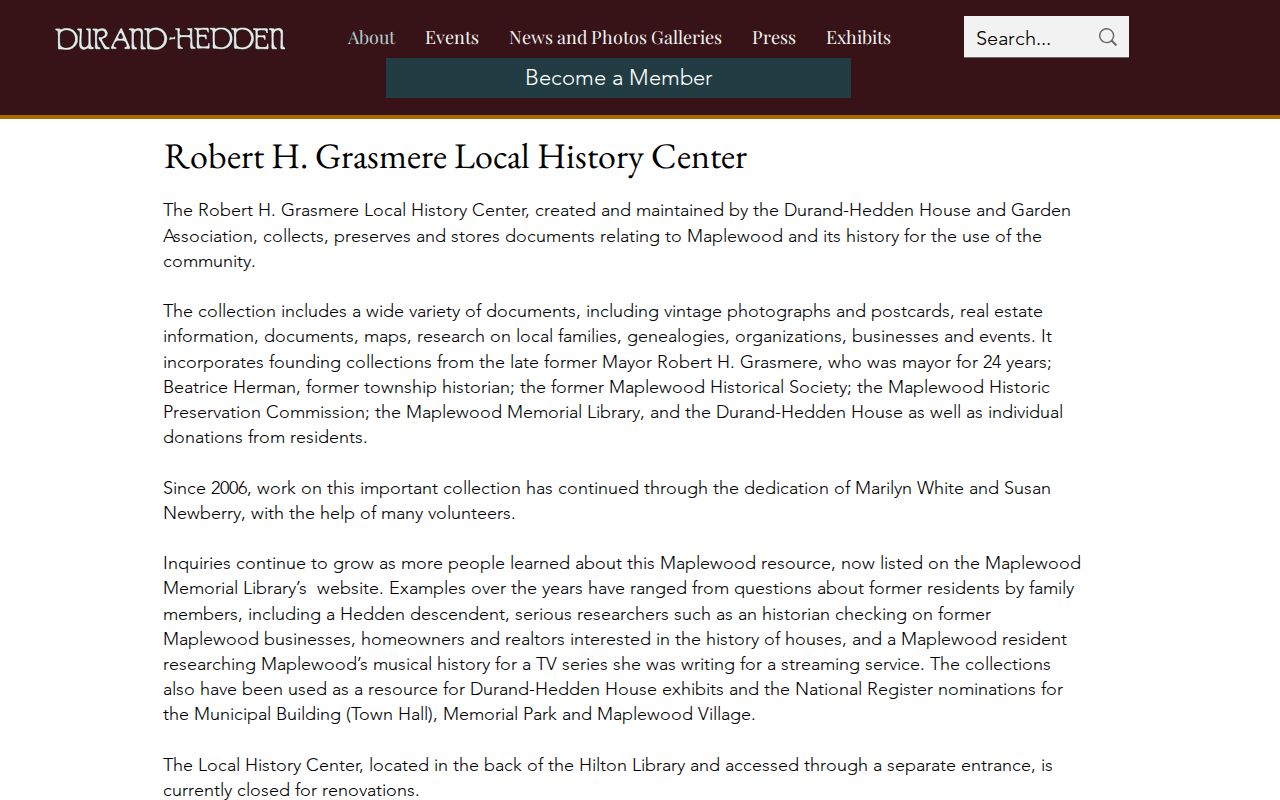
That collection offers historical context and finding aids. It does not supply a live Maplewood household roster.
Maplewood Previous Residents House History
The New Jersey Historic Preservation Office sets out a practical sequence for historic house research: locate the current grantee, move backward through the grantor and grantee indexes, preserve the book, page, date, and owner, check wills when the chain ends, then compare directories, census material, tax ratables, and newspaper advertisements. Maplewood can apply that method through PRESS, the library archive, local files, State Archives, and the Register's in-person access route.
The New Jersey Historic Preservation Office house-history guide illustrates the official workflow used as the backbone for the Maplewood record trail.
The method works best as a written timeline. For every record, retain the source URL, date, record type, search key, and a note stating whether it supports ownership, occupancy, or only building context.
Maplewood Previous Residents and Privacy
Some stops in an address history are lawful. Daniel's Law can redact covered public servants' home addresses and owner names in government web records. The New Jersey Address Confidentiality Program provides a substitute address and mail forwarding for eligible participants. Vital records have identity and eligibility rules, and court records can be sealed, expunged, or redacted. A blank field or unreturned name may be a protection, not a research error.
Lawful use. Maplewood past-residents research fits house history, family history, estate questions, and personal curiosity. Do not use a historical trail to track, contact, stalk, harass, or harm a living person, and do not try to reconstruct a protected address.
When an existing municipal record may help, a written request under the New Jersey Open Public Records Act should identify the record type, address or block and lot, named parties, and bounded date range for the correct custodian. Maplewood's request route is for existing records, not an open-ended request to create a history.